
Sales leadership for a few months. A sales process for good.
Growth is easier when sales runs on a process, not on effort.
Where sales gets stuck
In most growing companies, sales is one of the last functions to get a defined process. Some signs it hasn’t happened yet:
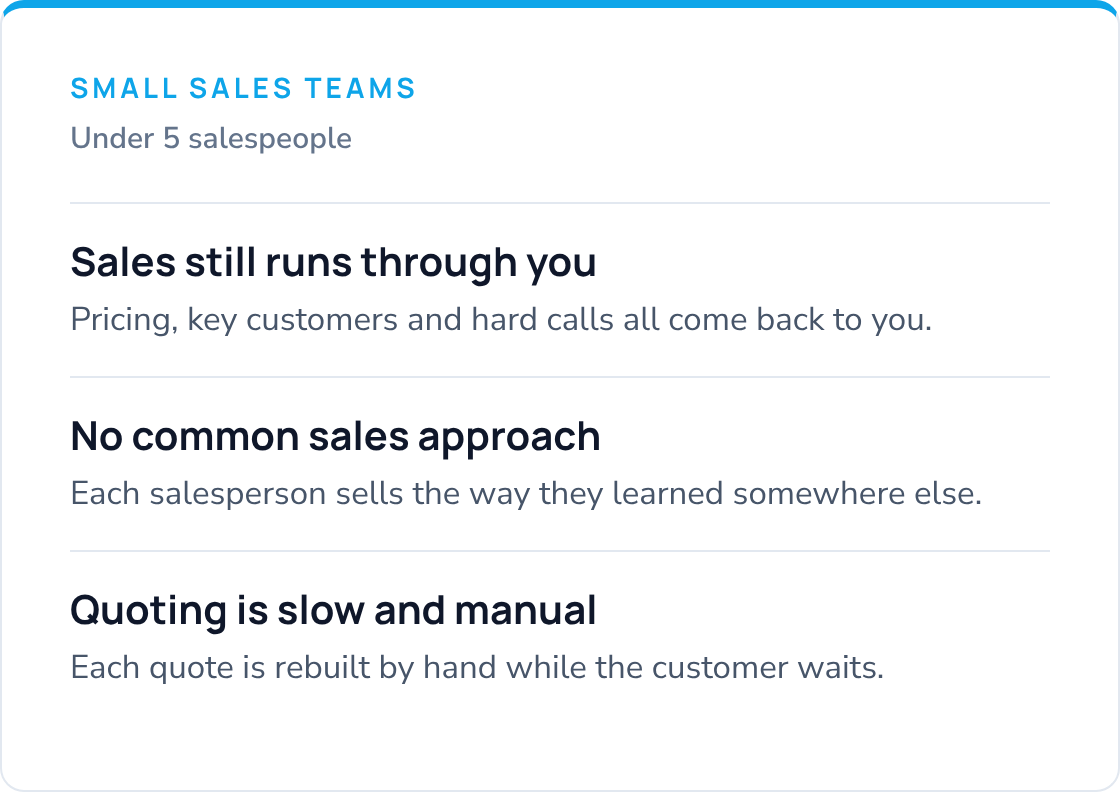
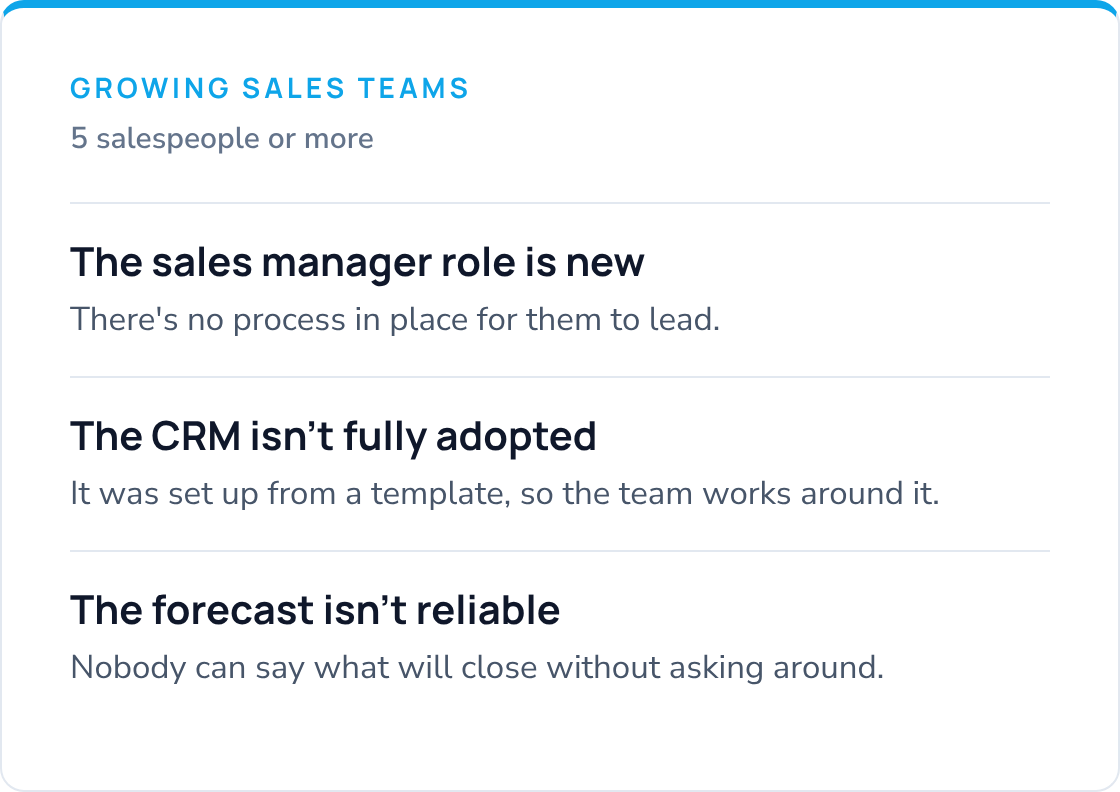
These don’t fix themselves. They get harder as the team grows.
How it gets fixed
Sales works when the people, the process and the tools fit the way your business sells. The goal is a process that makes selling easier, without turning salespeople into administrators.
The work runs in four phases:
Phase 1
Assess
About one month
A look at how sales runs today, across process, people and technology. Interviews with the sales team and the people who work closely with it. A review of the CRM, the quote history, and recent wins and losses.
ResultWritten findings and a ranked plan, clear enough to carry out on your own. Often the whole engagement.
Phase 2
Build
Two to three months
The sales process defined from first contact to close. Roles and standards set, including quote turnaround and follow-up. The team trained, and only the technology that's needed, set up to fit.
ResultA working process and a team trained to run it.
Phase 3
Run
Three to six months, overlaps Build
Half a day a week: the weekly sales meeting, one-on-ones with each salesperson, and pipeline review. A new process fades unless someone holds it through the first months, so what doesn't work gets adjusted along the way.
ResultA team that runs it every week without being reminded.
Phase 4
Hand off
A few weeks
Someone on your team takes it over, or a new hire trained into the role. The process is documented and that person is trained to run it. The commitment to hand it back is made from the start.
ResultThe engagement ends.
Enough structure to make execution and accountability possible, without turning good salespeople into administrators.
Where the work sits
Every customer is won and kept in five steps: strategy, demand, sales, delivery and support. The sales process is step three.
The first two steps bring customers in. The last two deliver and keep them. In between, every deal runs from the first lead to a handoff that holds.
Each stage moves a deal forward. What's learned in delivery shapes how the next deals come in.
Why Me
Twenty years in industrial technology and hardware, starting on the technical side and moving into sales. At Hexagon and u-blox: building and running global sales teams, introducing new products to market, setting sales strategy, running sales kickoffs, and putting CRM systems in place. Deals from around $50,000 to $15 million, sold direct and through partners.
Several of those years involved M&A, reviewing the sales process and the sales team of a company before acquisition and then implementing the changes once it came in. Comparing sales organizations side by side teaches you quickly which structures hold and which only look organized.
More recently, engaged directly by hardware companies to work on specific parts of their sales process.
No two of those sales organizations needed the same thing. The answer is always some mix of process, people and tools, with AI where it earns its place.
More about me

Thirty minutes is enough to tell whether there is something worth doing and whether the fit is right.